
Quick answer
Entry is $30 per vehicle (7-day pass). From Hilo, it's a 45-minute drive south on Hwy 11. From Kona, it's about 2.5 hours. Plan on a full day (6 to 8 hours) to do the park justice. Most of it is paved and our 15-passenger vans handle it without issue.
$30
vehicle, 7-day pass
335k
acres, sea to summit
4,000
ft, entrance elevation
19
mi down Chain of Craters
Getting there
From Hilo: straight south on Hwy 11. It's a 30-mile drive that climbs from sea level to about 4,000 ft at the park entrance. The Volcano village area, just outside the park gate, has gas, a general store, and a few restaurants. Fuel up in town on your way in.
From Kona: take Hwy 11 south around the island through the Ka'ū district. Allow 2.5 hours each way. For groups based in Kona, this is a long day out; consider pairing it with an overnight in Volcano village. If you're running a 7-day Big Island itinerary, we suggest basing in Hilo for Volcanoes day.
Start at the Kīlauea Visitor Center
Worth the twenty minutes. Rangers post the day's eruption status (Kīlauea has entered several eruption cycles since 2020), trail conditions, and road closures. There's a short orientation film and a small exhibit on Hawaiian volcanology that helps the rest of the day make sense.
Grab the paper map. Cell service disappears inside the park. Offline Google Maps helps too.
Crater Rim Drive
An 11-mile loop around the summit caldera (sections occasionally closed due to volcanic activity; check at the visitor center). Short stops:
- Steam Vents. Ground-water meets hot rock, steam comes out of the cracks. Five-minute walk to the rim.
- Sulphur Banks (Haʻakulamanu). Bright yellow sulfur crystals on volcanic mounds. The smell is real; ten-minute boardwalk.
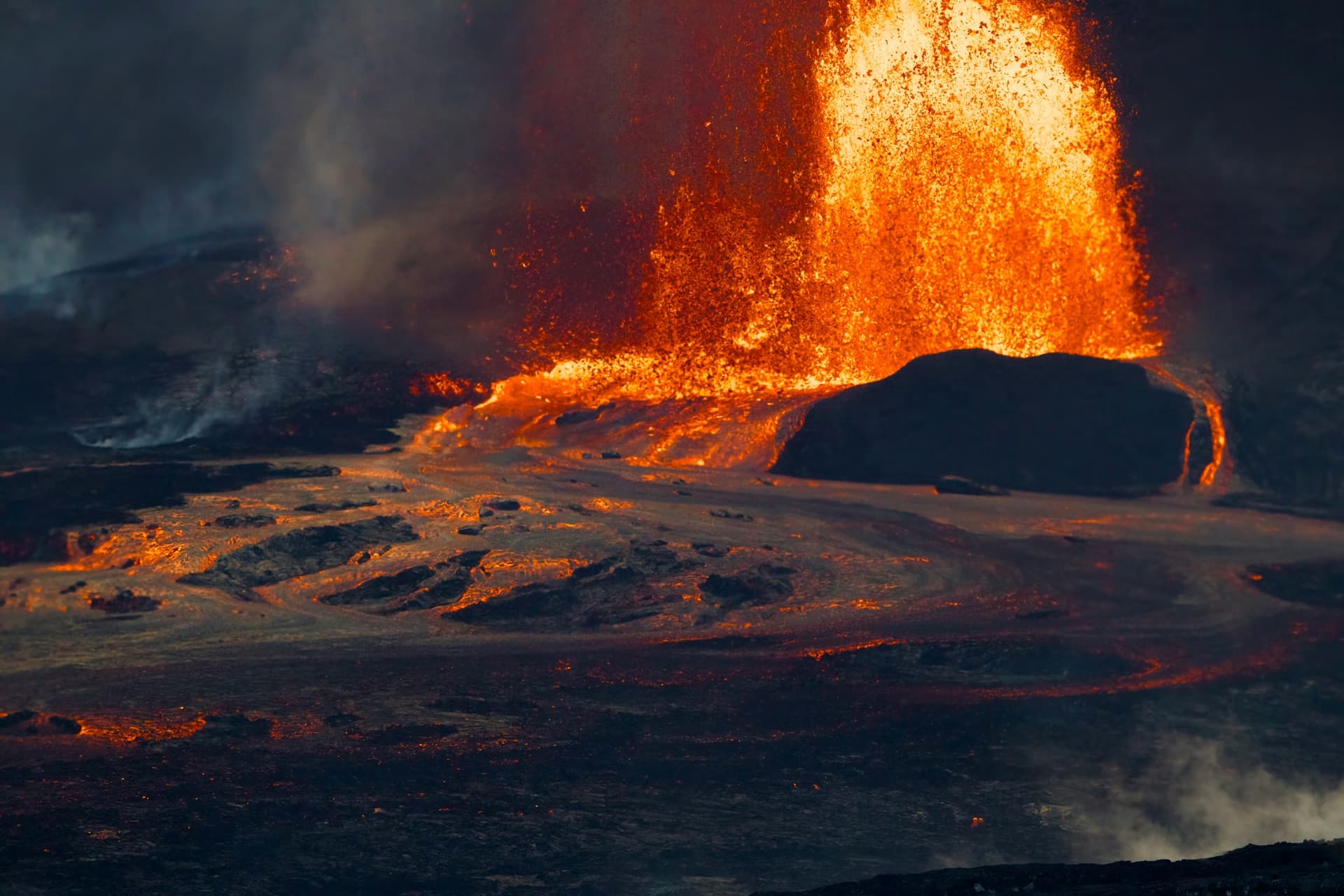
- Halemaʻumaʻu overlooks. Multiple viewpoints for the active crater within the caldera. If there's an ongoing eruption, these are the views. Dusk and after dark are the best light.
Kīlauea Iki Trail, the headline hike
A 4-mile loop that descends 400 feet to the floor of a crater that filled with a lava lake in 1959 and is still cooling. You walk through tropical rainforest on the way down, across a still warm-in-places crater floor, and back up the other rim. The surface underfoot is brittle, creaking pāhoehoe lava; you'll feel it shift under your weight in spots.
Plan two to three hours at a moderate pace. Wear closed-toe shoes; the lava is sharp and hot-pavement warm in the afternoon. Start at the Kīlauea Iki Overlook or at the Thurston Lava Tube lot and do the loop counterclockwise.
Thurston Lava Tube (Nāhuku)
A 500-year-old lava tube you can walk through, maybe 600 feet long, lit in the first section, dark and cooler in the back-half extension. Bring a flashlight if you want to go all the way through. Short, crowded, genuinely cool (both temperature and as an experience).
Chain of Craters Road, the underrated half
A 19-mile paved descent from the summit area at 4,000 ft down to the sea. The landscape changes dramatically every mile: rainforest, older lava flows, then recent flows that buried the road in places you can still see. It ends at the Holei Sea Arch, a 90-foot basalt arch where lava meets the Pacific.
Budget three to four hours round-trip. There's no gas and no water along this road. Fuel up in Volcano village before heading down and carry a cooler with water for the group.
The van handles the whole drive on paved road with ample pullouts at overlooks. This is where a passenger van earns its keep: one vehicle, one conversation, the whole group seeing the same thing at the same time.
Safety notes that matter
- Check eruption status the morning of your visit (hvo.wr.usgs.gov). During active eruptions, certain overlooks close and vog (volcanic smog) can be heavy.
- Vog (volcanic air pollution) can aggravate asthma. If you're sensitive, pick a non-eruption day or avoid the downwind side of the caldera.
- Weather. At 4,000 ft, it's often 10–15 °F cooler than Hilo and rain is common. Bring a rain shell.
- Stay on marked trails. Thin lava crusts can cover voids. This is not a theoretical risk.
- No pets on most trails. Service animals only.
With a van, specifically
Our 15-passenger van and 12-passenger van both park comfortably at all the main lots inside the park. Rear A/C helps on the climb back up from Chain of Craters on a hot afternoon. Gas up in Volcano village before dropping down.
If you're flying in specifically for this park, look at Hilo (ITO) delivery . It's the closer of the two airports and the one we'd pick.
Mini-FAQ
- How much is entry to Hawai'i Volcanoes National Park?
- $30 per vehicle for a 7-day pass as of the most recent NPS update. The Annual Hawai'i Tri-Park Pass covers Volcanoes, Haleakalā, and Pu'uhonua o Hōnaunau for $55. America the Beautiful federal passes are also accepted.
- How far is Volcanoes National Park from Hilo?
- About 45 minutes by car or van, a 30-mile straight shot south on Hwy 11 from Hilo International Airport (ITO). The park entrance is at roughly 4,000 ft elevation.
- How far is Volcanoes National Park from Kona?
- About 2 hours 30 minutes from Kailua-Kona via Hwy 11 south, or slightly longer via Saddle Road / Hwy 200 through Hilo. Plan a full day if you're day-tripping from the Kona side.
- Can you see active lava at Volcanoes NP?
- Sometimes. Kīlauea's eruptions come and go. Check the USGS Hawaiian Volcano Observatory (hvo.wr.usgs.gov) the morning of your visit for real-time eruption status. When Halemaʻumaʻu is active, the overlooks along Crater Rim Drive give the best views, and night visits are worth the drive.
- Is there gas in the park?
- No. The nearest gas station is in Volcano village, about 1 mile from the entrance on Hwy 11, or in Nāʻālehu 30 miles south. Chain of Craters Road is 19 miles down to the sea and 19 back, with no services. Fuel up in Volcano village before heading down.
- Can I drive a 15-passenger rental van in the park?
- Yes. All the main park roads (Crater Rim Drive, Chain of Craters Road, Mauna Loa Road) are paved and van-friendly. Parking lots at all the major stops can accommodate a 15-passenger van.