
In short
Fly into Hilo (ITO), fly out Kona (KOA), or vice versa. The one-way trip earns you two extra hours a day you'd otherwise spend on re-crossings. We can deliver at one airport and pick up at the other. Total driving over the week: roughly 550 miles, all paved, averaging 80 mi/day. Our 15-passenger van handles the whole route without drama.
550
mi over the week
80
mi/day average
2
coasts, one van
15
seats, one conversation
Day 1 · Land in Hilo, get oriented
Most direct-from-mainland flights hit ITO in the late morning or afternoon. We meet you at ITO (how our Hilo van rental handoff works). Keys in hand inside fifteen minutes, then it's a short day on purpose.
- Drive to your Hilo-side lodging, drop bags.
- Rainbow Falls (Wailuku River SP). 15 min from downtown, free, big-reward photos with no effort.
- Downtown Hilo for an early dinner. Suisan for poke (sit at Liliʻuokalani Gardens), or Moon & Turtle / Pineapples for sit-down.
- Early night. Tomorrow is the big one.
Driving: roughly 18 miles round-trip, 45 minutes total. Fuel: top off before tomorrow. Volcanoes day is long.
Day 2 · Hawai'i Volcanoes National Park, full day
Straight shot south on Hwy 11, 45 minutes from Hilo to the park entrance. $30/vehicle gets you a 7-day pass. Plan on being in the park 6–8 hours; the payoff is massive. Full stop-by-stop in our Hawai'i Volcanoes NP guide.
- Kīlauea Visitor Center: 20 minutes, get the map + eruption status.
- Steam Vents and Sulphur Banks: quick stops on Crater Rim Drive.
- Kīlauea Iki Trail: the 4-mile crater-floor loop. Do this.
- Thurston Lava Tube (Nāhuku): 15 minutes, tour bus magnet.
- Chain of Craters Road: 19 miles down to Holei Sea Arch. No gas, no services past the visitor center; bring water.
- Back to Hilo for dinner.
Driving: about 110 miles and 2.5 hours behind the wheel, before in-park stops.
Day 3 · Saddle Road across, Mauna Kea at sunset
The crown-jewel day. Hilo is an hour and fifteen from the Mauna Kea Visitor Information Station at 9,200 ft. You'll want to acclimatize for a minimum of 30 minutes at the VIS before doing anything strenuous.
Morning / early afternoon
- Slow start. Hilo Farmers Market if it's a Wed or Sat.
- Drive Saddle Road (Hwy 200) to the turnoff. See Saddle Road tips.
- Pack warm layers. Nighttime summit-area temps are 30–45 °F year-round.
Late afternoon / evening
- Arrive at the Visitor Information Station by 4 p.m.
- Sit. Drink water. Let your body adjust.
- Sunset above the cloud line. Then stargazing.
- Do not drive past the VIS. The summit road is unpaved and rental vans (ours included) are prohibited from it. The Mauna Kea driving guide covers this in detail.
Safety note for groups: children under 16, pregnant passengers, and anyone with heart / lung issues should stay below 6,000 ft. That means skipping the VIS, not "taking it slow." It's a hard altitude line, not a suggestion.
Driving: about 130 miles round-trip, 3 hours 15 minutes behind the wheel.
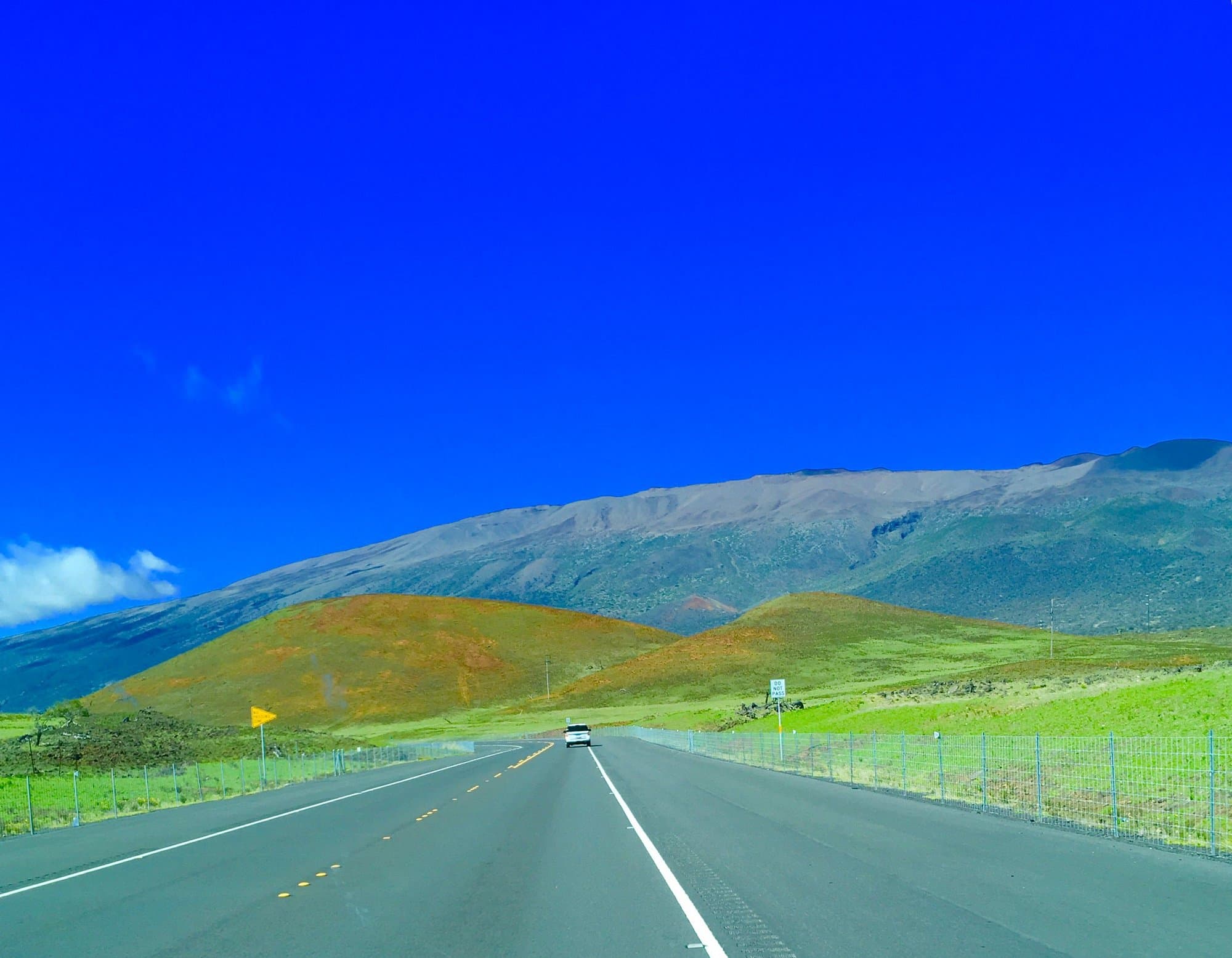
Photo: Saddle Road crosses the open pasture between two of the world's largest volcanoes.
Day 4 · Cross to the Kona side via the north
Check out of Hilo, drive up the Hamakua Coast, cross through Waimea, and drop down to the Kohala / Kona coast. This is the scenic way across, more interesting than Saddle Road twice.
- Stop at Akaka Falls State Park. 20-minute loop walk, 442-foot waterfall. $5 per out-of-state vehicle.
- Waipi'o Valley Overlook. The overlook only. The valley road is 4WD / resident-only.
- Lunch in Waimea: Village Burger, Big Island Brewhaus, or Merriman's for a special-occasion sit-down.
- Down to Hapuna Beach State Park for late afternoon.
- Check into your Kona / Kohala lodging.
Driving: about 95 miles with stops, a little under 3 hours behind the wheel.
Day 5 · Kona coffee country + Kealakekua Bay
A slower day. The south-Kona hills are where the coffee grows and where the island's oldest history is preserved.
- Morning: one Kona coffee farm tour. Greenwell, Mountain Thunder, or Hula Daddy.
- Lunch around Captain Cook / Kealakekua.
- Kealakekua Bay and Captain Cook Monument. Snorkel from the small county beach at Napoʻopoʻo. Serious snorkelers should book a morning kayak or boat tour to the monument side.
- Pu'uhonua o Hōnaunau National Historical Park, the "Place of Refuge." $20/vehicle (or use your Volcanoes pass). 90 minutes minimum. One of the most meaningful cultural stops on the island.
- Sunset on Aliʻi Drive in Kailua-Kona.
Driving: ~55 miles, ~2 hours.
Day 6 · South Point and the far south
The longest driving day of the week. Worth it for the sheer weirdness of Papakōlea and the black-sand drama of Punalu'u.
- South Point (Ka Lae), southernmost point in the United States. Paved road all the way to the parking area. Cliff-jumping platform; be honest about your comfort with 40-foot drops.
- Papakōlea (Green Sand Beach). Park at South Point, then walk the 2.5-mile cinder track each way, or pay a local shuttle (~$20/person round-trip). Do not attempt the cinder track in the van. See Green Sand Beach guide.
- Punalu'u Black Sand Beach on the way back north. Snack, photograph green sea turtles from 10+ feet away, do not touch.
- Dinner in Kailua-Kona.
Driving: about 160 miles, 3.5 hours in motion.
Day 7 · Buffer + flight out
Build a real buffer. The whole island is one traffic accident away from a missed flight if you plan tight.
- Late breakfast at Daylight Mind or Basik Acai.
- One last beach: Manini'owali / Kua Bay for quick sun.
- Be back at KOA with two hours to spare. We pick up the van at the same airport. If you flew in one side and out the other, same process at ITO. See how airport delivery works.
What to pack in the van
- Rain shells for the Hilo side and any day on the windward coast.
- Warm layers + beanies for Mauna Kea. Seriously, it gets to 30 °F.
- Closed-toe shoes for lava-rock walking.
- Reef-safe sunscreen (Hawaiian law, and the reefs thank you).
- Offline Google Maps for Saddle Road / Chain of Craters. Cell service dies.
- Cooler. Every day is a picnic day on this island.
- One phone mount at the driver's seat. Do not rely on passenger-side navigators.
When to go
Weather here is more about which side than which month. The drier, warmer side is Kona. The wetter, cooler side is Hilo. April–May and September–October tend to be the best mix of lower prices, smaller crowds, and fine weather either side. Winter is whale season (humpbacks, December–April). Summer is hot on the Kona side, so book morning activities.
Why this works with a van (and not four sedans)
Twelve to fifteen seats, one driver rotating across the group, one shared cooler, one conversation the entire week. Both the 15-passenger and 12-passenger vans have rear A/C (non-trivial on Saddle Road and south-Kona afternoons). Seats are fixed — no re-configuring for cargo — so pack soft-sided. See the group-travel page for trip-captain tips.